

AI Agents For SEO – Automation has always played a big role in SEO, helping teams organize information, create reports faster, and reduce repetitive tasks. Today, AI agents take this further by combining workflow automation with AI-powered capabilities, allowing them to handle multiple tasks across different systems.
Among these tools, n8n stands out for its flexibility and control. Here’s a simple breakdown of how it works and how it fits into today’s SEO processes.
AI agents can assist with optimizing your website for search engines, including generating content efficiently and analyzing performance metrics. However, it’s also important to understand fundamentals like how to find the perfect content length for SEO to ensure your content ranks effectively.
Understanding How n8n AI Agents Are Set Up
If you think of modern AI agent platforms as an AI-powered version of Zapier, you’re close. But tools like n8n do more than just move data between steps — they can analyze it, change it, and decide what to do next.
When starting with n8n, you have two options: cloud-hosted or self-hosted.
Cloud-hosted n8n (where n8n manages everything for you) has some limitations:
The environment is more restricted.
You can’t customize the server to handle workflows in special ways, like saving certain files to a database.
You can’t add community-created nodes.
Costs are usually higher.
But there are also advantages:
You don’t need to manage the server or worry about updates.
It’s easier to set up and requires less technical knowledge — you don’t need a developer.
Maintenance is simpler and less stressful, even if customization is limited.
n8n also offers different license options. If you self-host, it can be free, but this can get tricky for larger teams since the free version has limited version control and tracking of changes.
How n8n Workflows Operate in Practice
No matter which n8n plan you choose, using AI models and large language models (LLMs) isn’t free — you’ll need API keys from providers like Google, OpenAI, or Anthropic.
After installing n8n, you’ll see a clean and simple interface with a drag-and-drop canvas. This makes it easy to design workflows, much like how Zapier works.
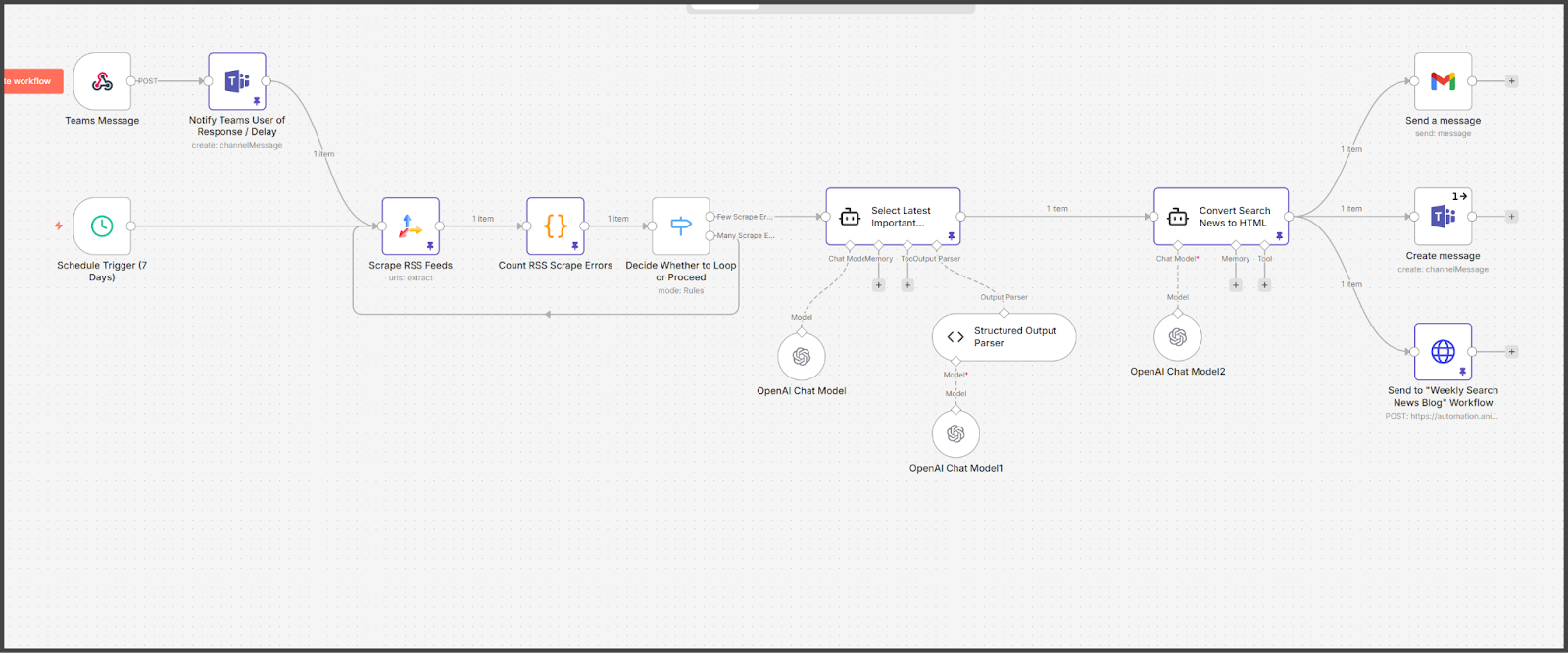
In n8n, you can add nodes to pull in data from different sources. For example, webhook nodes can trigger workflows on a schedule, when someone submits a contact form, or from another system.
Once a workflow runs, it can send the results to destinations like Gmail, Microsoft Teams, or HTTP request nodes, which can start other workflows or connect with external APIs.
For example, a simple workflow can scrape RSS feeds from multiple news sites and create a summary. While it doesn’t generate a full news article or blog post, it saves a lot of time by quickly highlighting the key updates.
Creating AI Agent Workflows in n8n
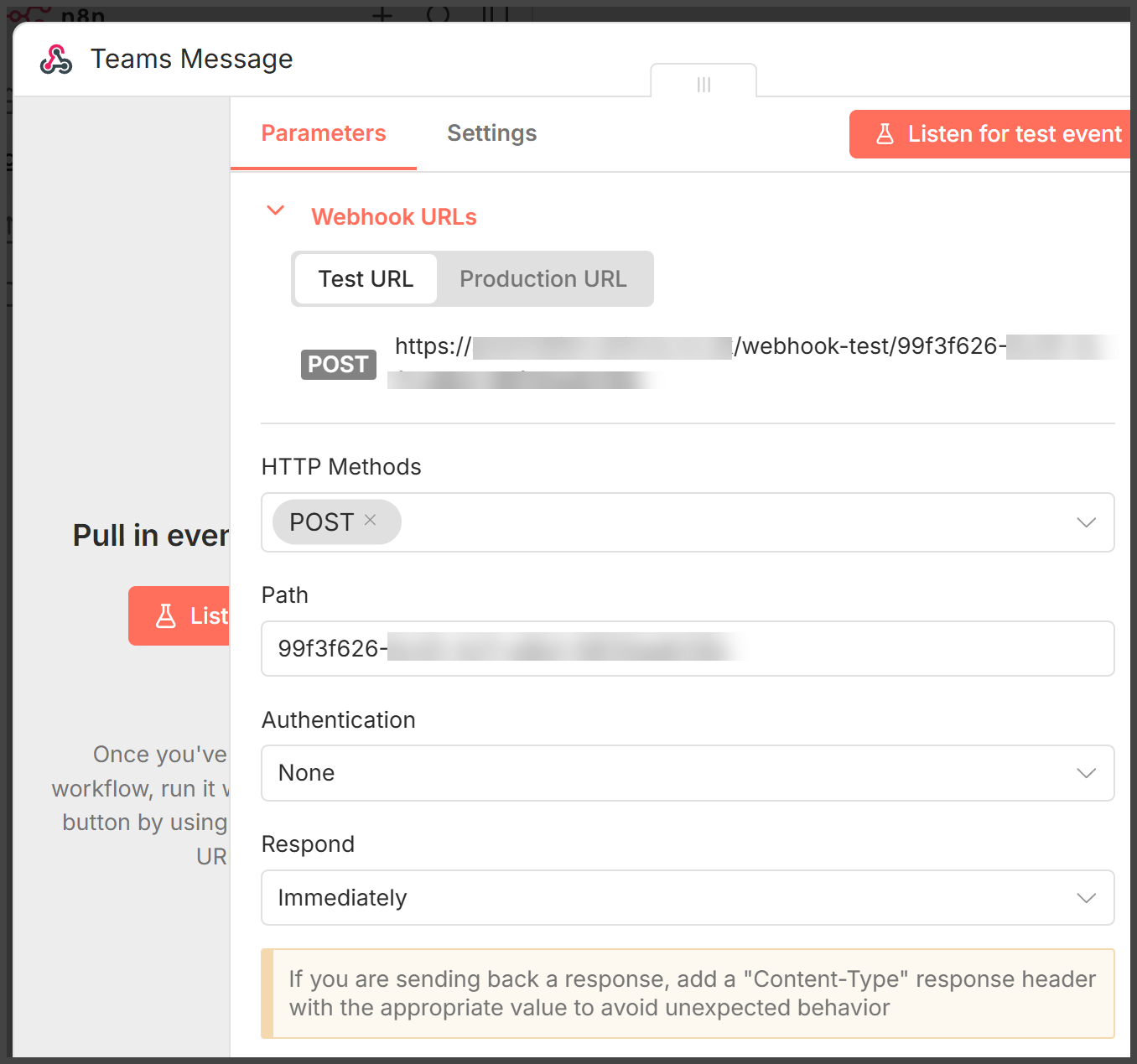
Here’s how a webhook trigger node works in n8n. This node generates a webhook URL, which can be called by apps like Microsoft Teams through an “Outgoing webhook.” When Teams sends a request to this URL, the workflow in n8n starts automatically.
For example, a user can request a news update directly from a Teams channel. n8n then takes over, processes the request, and sends back the response — all automatically.
Once you start creating AI agent nodes that connect with large language models (LLMs) from providers like OpenAI, Google, or Anthropic, it becomes easier to see what the platform can really do.
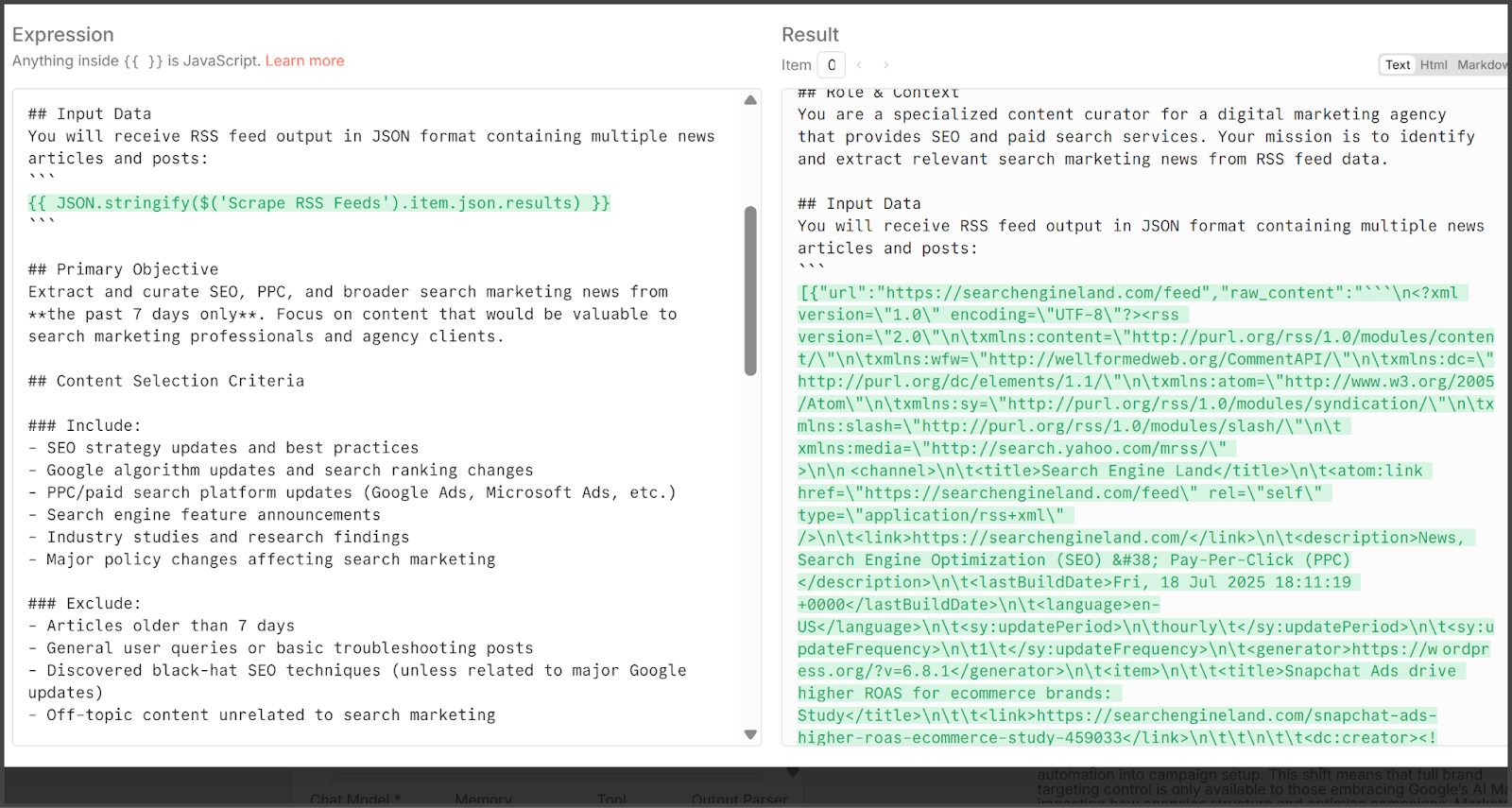
In the image above, the left side shows where you create the prompt. You can dynamically use variables from nodes that ran earlier. On the right side, you see the prompt’s output for that run, which is then sent to the chosen LLM.
For example, data from a scraping node — like content from multiple RSS feeds — is added to the prompt to create a summary of recent news. The prompt uses Markdown formatting to make it easier for the LLM to understand and process.
Back in the main AI agent node view, you’ll notice that two prompts can be used in the workflow.
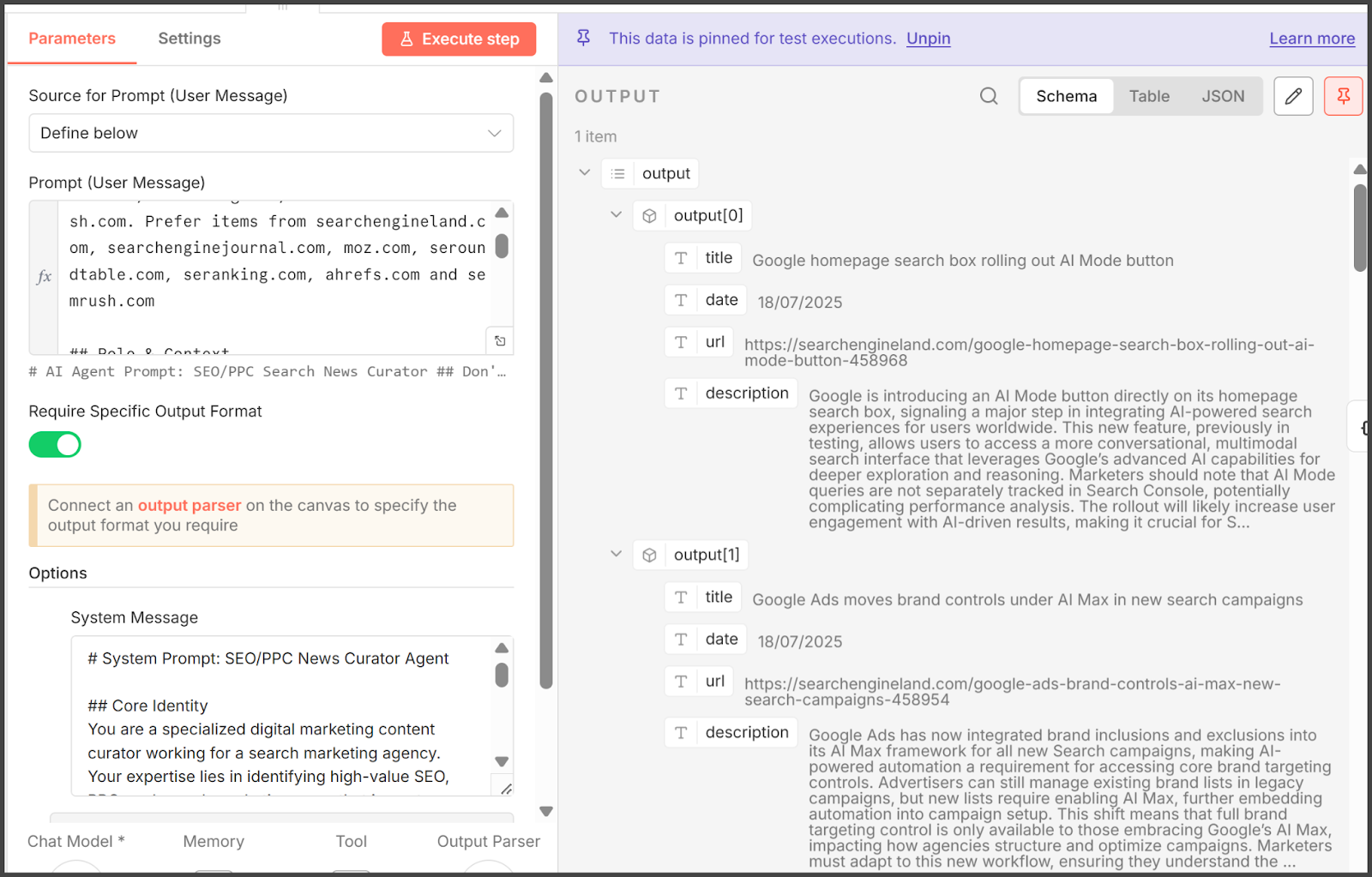
The user prompt tells the AI what role it should take and maps dynamic data by inserting labeled variables, so the AI knows exactly what it is working with. The system prompt gives more detailed instructions, including how the output should look and examples of formatting. Both prompts are usually long and written in Markdown for clarity.
On the right side of the interface, you can see a sample output. Data moves between n8n nodes in JSON format. In this example, the view is switched to “Schema” mode, which makes it easier to read and debug. The full raw JSON output can also be seen in the “JSON” tab.
This workflow uses two AI agent nodes to complete the project successfully.
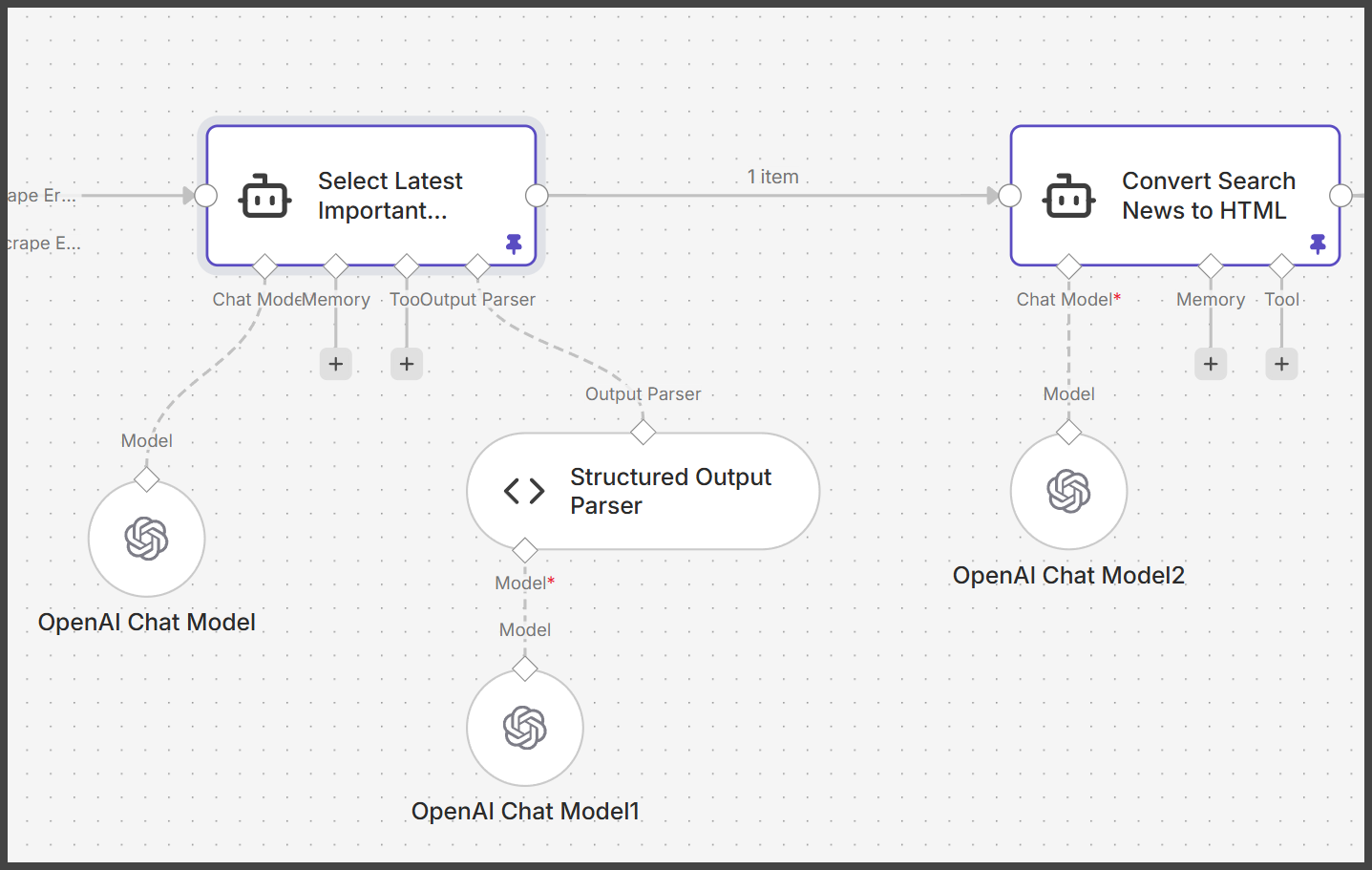
The short news summary needed to be converted to HTML so it could be delivered via email and Microsoft Teams, both of which support HTML.
The first node handled summarizing the news. However, when the prompt became large enough to generate the summary and perform the HTML conversion in a single step, performance began to degrade, likely due to LLM memory constraints.
To address this, a second AI agent node converts the parsed JSON summary into HTML for delivery. In practice, a dual AI agent node structure often works well for smaller, focused tasks.
Finally, the news summary is delivered via Teams and Gmail. Let’s look inside the Gmail node.
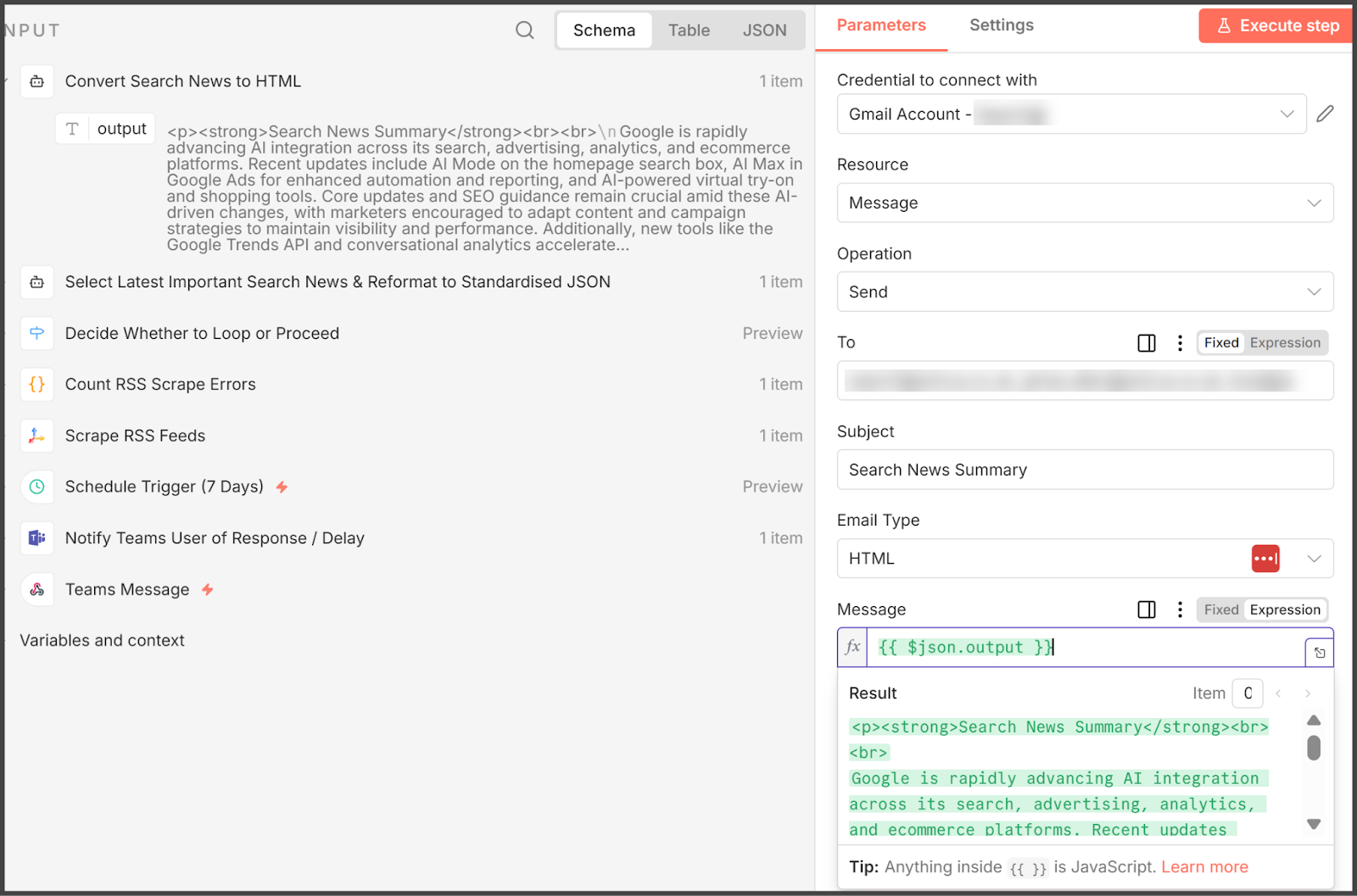
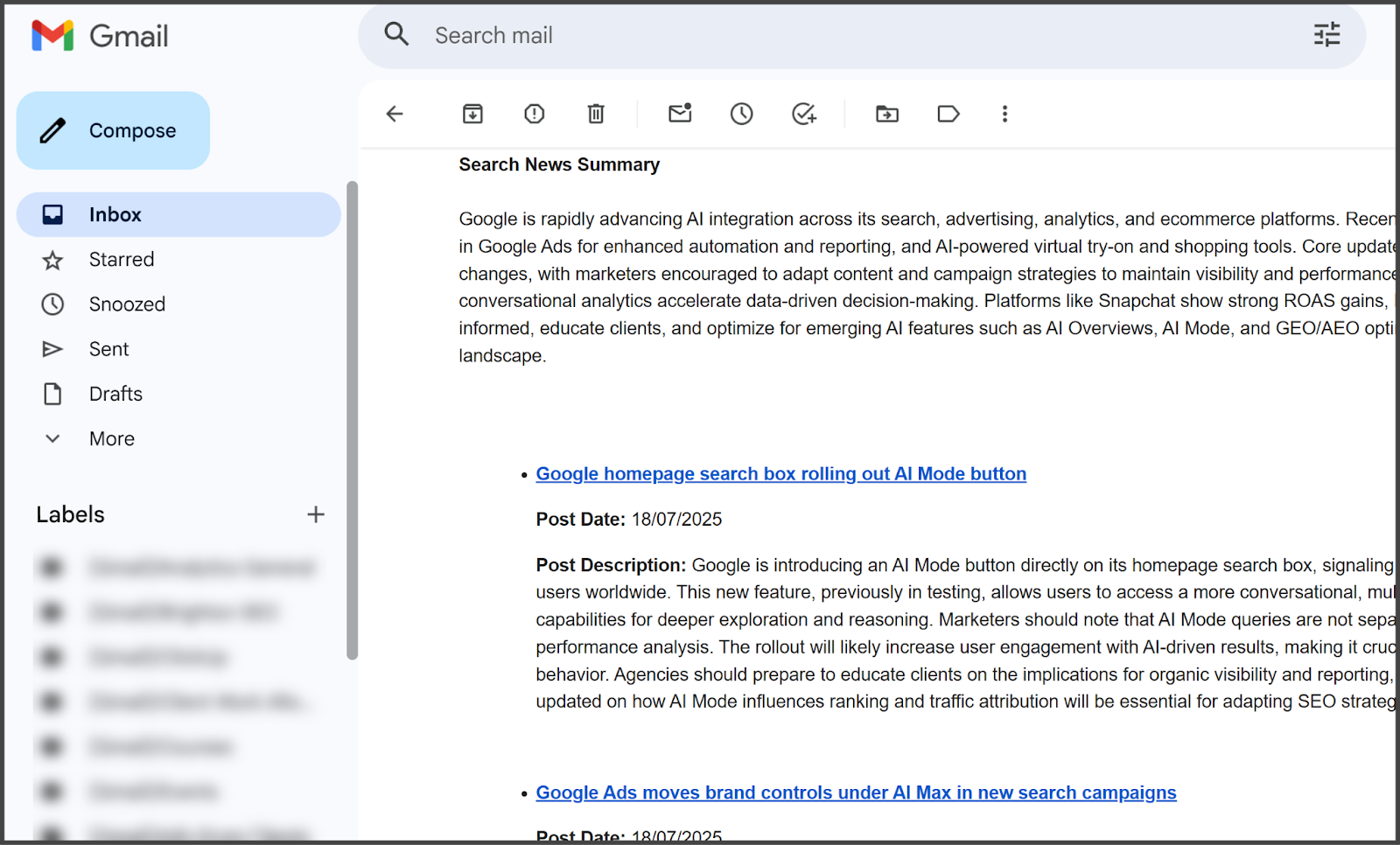
The Gmail node takes the HTML content created by the second AI agent node and builds the email. Once the workflow runs, the email is sent automatically without any manual effort.
n8n SEO Automations and Other Uses
In this article, we looked at a basic example of what n8n can do. But in reality, n8n offers many more possibilities for SEO and digital marketing tasks. Here are just a few examples:
Creating full-length content and detailed articles, not just summaries.
Writing short content pieces like meta descriptions and Open Graph tags.
Reviewing web pages from a conversion (CRO) or user experience (UX) point of view.
Generating or editing code snippets.
Building small, one-page SEO scanning tools.
Making schema testing and validation tools.
Producing internal documents such as job descriptions.
Reviewing CVs or resumes automatically.
Connecting with other platforms to manage bigger and more complex workflows.
Using custom HTTP request nodes to connect to APIs that don’t have built-in n8n integrations.
The possibilities are nearly endless. As one expert put it, “If I can think it, I can build it.” That might sound a bit exaggerated, but it shows how flexible n8n really is.
Of course, n8n isn’t perfect. Like all tools, it has its limitations. Still, n8n — along with platforms like MindStudio and Make — is changing how teams think about automation and workflow design in marketing.
How long this shift will last is hard to say. Some professionals are already exploring locally hosted tools like Claude Code and Cursor, or even building their own AI systems that run directly on their laptops and connect to large language models (LLMs).
Even so, tools like n8n are likely to stay popular, especially among users who are somewhat technical and want both automation and control.
Drawbacks of n8n
While n8n is powerful, there are a few things to keep in mind:
The platform is still developing, and major updates can sometimes cause issues with nodes, servers, or workflows.
This isn’t unique to n8n — the AI industry itself is still evolving, which means frequent changes and extra maintenance for now.
Some teams may hesitate to use automation due to job security concerns or ethical concerns.
n8n shouldn’t replace human roles — it’s a support tool, not a full substitute. Human review is still necessary.
While n8n can connect multiple LLMs, it isn’t ideal for deep technical audits or large-scale data analysis.
Connected LLMs can hit memory limits or make small logic errors — for instance, flagging a missing meta description on an image page that doesn’t actually need one.
Current AI systems don’t yet have the memory or reasoning power to handle very complex or subjective tasks.
The best way to use n8n is to start small — automate the repetitive or time-consuming tasks your team struggles with. From there, you can expand into more complex systems, as long as the data and workflows remain clearly defined.
SEO’s Move Toward Automation and Workflow Management
AI agents and platforms like n8n are not here to replace SEO professionals. Instead, they enhance human work. They help reduce repetitive tasks, speed up routine analysis, and give SEOs more time to focus on strategy and decision-making. This is a familiar trend in SEO — automation doesn’t remove value; it shifts it toward higher-level work.
The most noticeable improvements usually come from small, practical workflows rather than massive overhauls. Simple automations, like summarizing data, organizing outputs, or linking different systems, can save time and improve efficiency without making things complicated. When combined with human oversight and context, these tools become far more reliable and useful.
Looking to the future, AI tools will keep improving, and the trend is clear: SEO is becoming increasingly connected with automation, data engineering, and workflow orchestration. Learning how to build, manage, and work alongside these systems is likely to become a key skill for SEOs in the coming years.
Conclusion
AI agents are transforming the way SEO workflows are managed, making routine tasks faster, data easier to organize, and results more actionable. Tools like n8n show how automation can enhance human expertise, allowing SEOs to focus on strategy, creativity, and decision-making rather than repetitive work.
While AI and automation won’t replace the human touch, they provide a powerful boost to efficiency and accuracy when used thoughtfully. By starting with small, practical workflows and building up, businesses can unlock meaningful results without overcomplicating their processes.
At A99 Solutions, we specialize in leveraging AI-driven tools and automation to create smarter, more effective SEO strategies. Whether you’re looking to streamline your workflows, improve content delivery, or gain better insights from your data, our team can help you implement the right solutions tailored to your business. Partner with A99 Solutions to stay ahead in the evolving world of AI-powered SEO.