

Sometimes, a company website may have to manage hundreds or even thousands of content pages, depending on the nature of the business and its industry experience — and that’s where the benefits of content pruning in SEO come in, helping remove outdated pages, boost rankings, and keep the site performing at its best.
Having a large number of content pages on your website can be a sign of growth, but if it becomes excessive, it can strain your server and potentially harm your search engine optimization efforts.
If you find yourself in such a situation, content pruning can be the solution. Let’s discuss this in the sections below:
Content Pruning?
Content pruning is the process of evaluating and removing outdated, irrelevant, or underperforming content from your website.
The primary focus of content pruning is to enhance the overall quality of the website and retain only the content that resonates with your audience.
Top 5 Benefits Of Content Pruning
Content Pruning offers several advantages for websites and businesses. Let’s talk about the Top 5 benefits of content pruning for supporting website performance and, most importantly, user satisfaction.
1) Improves User Experience
User experience is always a primary factor in any website’s success. Visitors expect to find clear and useful information when browsing your website.
If you regularly clean up content on your site, it will help users navigate more efficiently and effectively, ultimately improving the overall experience.
When your website is free from unnecessary or irrelevant content, it performs better, especially:
- Streamlined navigation
- Faster page load times
- Improved user experience
2) Improve Content Standards
Content pruning for SEO ensures that only effective and relevant content remains on your website. By focusing on the benefits of content pruning in SEO—such as improving rankings, boosting user trust, and enhancing site performance. Outdated or redundant pages can damage your credibility, reduce audience trust, and hurt your search rankings.
During the cleanup process, review the pieces of content that can be refreshed, consolidated, or removed.
For example, if you have a blog with outdated information or statistics, you can update it to ensure it remains useful and accurate for your audience.
By following these practices, your website’s credibility will improve, boosting its reputation in the eyes of both your target audience and search engines.
3) Improve Organic Reach
Websites with high-quality, focused content have a greater chance of ranking well in search engines because Google prioritizes fresh and relevant content.
You might have a few strong pages on your website, but if you also have low-quality pages, search engines may still give you poor rankings.
Updating the keywords in your old blog posts with new, relevant ones can lead to better organic traffic, higher overall visits, improved engagement, and a stronger online presence for your website or business.
4) Improved link authority distribution
Link authority, also known as link equity, refers to the value or ranking power passed from one page to another through a link.
Poor link authority distribution can be caused by outdated or irrelevant pages, which can negatively affect your SEO rankings.
By pruning your content, you ensure that links remain between high-quality pages.
5) Better Crawling and Indexing
Search engines like Google have something called a crawl budget — this means they can only check and save a certain number of your website pages in a set amount of time.
If your site has too many old or poor-quality pages, it can make this process harder. Search engines might waste time on those weak pages instead of your good ones.
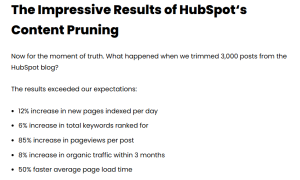
According to Marketing Scoop, HubSpot’s 2019 content pruning — which involved deleting over 3,000 outdated blog posts — resulted in a 12% increase in new pages indexed per day, 6% more keywords ranked for, 85% more pageviews per post, 8% organic traffic growth in three months, and 50% faster average page load speed.
Conclusion
Content pruning is a simple but powerful way to improve your website’s performance. By removing outdated or low-quality pages, you help search engines focus on your best content, speed up indexing, and boost your SEO rankings. This process not only makes your site cleaner and easier to navigate but also provides a better experience for your visitors.
If you want your website to perform at its best, regularly reviewing and pruning your content is a smart strategy you shouldn’t ignore.
Ready to improve your website’s SEO? You can contact us today to get expert help with content pruning and other SEO strategies!